
Views: 0 Author: Site Editor Publish Time: 2026-10-01 Origin: Site


Stricter regulatory frameworks and mandatory ESG reporting have completely shifted industrial operations. They have transformed environmental monitoring from a basic compliance checkbox into a critical operational asset. Proactive facility management now relies entirely on accurate, continuous sensor data. Without reliable data streams, facilities risk severe penalties and dangerous environmental impacts.
Selecting the right hardware is still only half the battle. Buyers often struggle with frustrating data silos and equipment failing to sync with modern reporting software. Unreliable hardware quickly creates operational blind spots, causing stressful compliance breaches. Poor integration leaves teams buried under manual data entry tasks.
This guide provides a robust framework for evaluating your monitoring systems. We explore compliance readiness, integration capabilities, and practical deployment strategies. You will discover exactly how to choose hardware aligned directly with your operational goals. Read on to master the procurement of highly effective monitoring solutions.
Compliance first: Instrument selection must align strictly with local and international regulatory standards (e.g., EPA, MCERTS, TÜV, ISO 14001) to ensure data validity.
Data integration drives value: Real-time continuous monitoring is only effective if the hardware integrates seamlessly with emissions reporting and facility management software.
TCO exceeds initial purchase price: Budgeting must account for routine calibration, sensor replacement, continuous software licensing, and specialized training.
Application dictates technology: Choosing between continuous real-time sensors and periodic sampling depends on specific operational risks and compliance thresholds.
Procurement must start by identifying your primary business driver. You must frame the exact problem you intend to solve before evaluating hardware. Some organizations purchase environmental monitoring instruments to avoid heavy regulatory fines. Others need verifiable data to achieve aggressive ESG milestones. Many industrial plants focus primarily on improving worker safety or optimizing intricate manufacturing processes. Pinpointing this core motivation ensures you align technical specifications with actual business needs.
You must next assess the business case for real-time versus periodic monitoring. Continuous monitoring instruments deliver immediate alerts and automate your regulatory reporting. They provide a constant stream of actionable intelligence. Conversely, periodic sampling tools work well for simple baseline tracking. They require manual intervention but suit environments where rapid changes rarely occur. You should base this decision on your specific operational risks. High-risk zones demand continuous oversight, while stable environments may only require weekly or monthly spot checks.
Defining clear success criteria guarantees a measurable return on your investment. You need explicit metrics to evaluate deployment performance over time. A successful deployment might target 99% data uptime across all connected sensors. You could aim for zero compliance breaches during the fiscal year. Another vital metric involves reducing manual data entry hours. Automating data transfers from field sensors directly into management software frees up engineering resources. Establishing these benchmarks early prevents scope creep and keeps vendor negotiations focused on tangible outcomes.
Understanding the distinct Types of environmental monitoring allows you to select the exact hardware categories necessary for your facility. Different environments demand highly specialized sensor arrays and data collection methodologies.
Air quality tracking focuses heavily on particulate matter like PM2.5 and PM10. It also measures volatile organic compounds (VOCs) and various greenhouse gas emissions. Industrial facilities require precise measurement of these pollutants to maintain safe breathable air. You must deploy robust instruments to track these invisible threats.
Key Instruments: Continuous Emission Monitoring Systems (CEMS), automated air samplers, and portable gas detectors.
Buyer Context: These instruments remain essential for monitoring industrial exhaust stacks. Global buyers navigating cross-border carbon regulations rely on them heavily. Cleanroom environments also depend on them to maintain sterile conditions.
Water monitoring targets core parameters like pH levels, dissolved oxygen (DO), and turbidity. It also tracks total suspended solids (TSS) and utilizes sludge blanket detection. Maintaining proper water chemistry prevents ecological damage and secures regulatory permits. Accurate sensors detect harmful chemical imbalances before they reach public waterways.
Key Instruments: Multi-parameter sondes, inline process sensors, and automated water samplers.
Buyer Context: Wastewater treatment facilities consider these tools critical for daily operations. Manufacturing plants use them to ensure discharge compliance. Municipal water management districts rely on them to safeguard drinking water supplies.
Condition monitoring tracks physical disruptions like vibration and ambient noise levels. It includes soil contamination assessment and the collection of localized meteorological data. Tracking these factors protects nearby communities from industrial nuisances. It also preserves the structural integrity of your own physical assets.
Key Instruments: Vibration analyzers, sound level meters, and automated weather stations.
Buyer Context: Construction sites use these devices to maintain local noise ordinance compliance. Heavy industries deploy them for machinery predictive maintenance. Agricultural operations use weather data to optimize crop yields.
Environmental Monitoring Technologies Comparison Summary
Monitoring Type | Primary Focus | Common Instruments | Typical Application Scenarios |
|---|---|---|---|
Air Quality | PM2.5, VOCs, Greenhouse Gases | CEMS, Portable Detectors | Industrial Stacks, Cleanrooms, Urban Zones |
Water Quality | pH, DO, Turbidity, TSS | Multi-parameter Sondes | Wastewater Treatment, Municipal Supplies |
Acoustic & Condition | Vibration, Noise, Weather | Sound Meters, Weather Stations | Construction Sites, Heavy Machinery, Agriculture |
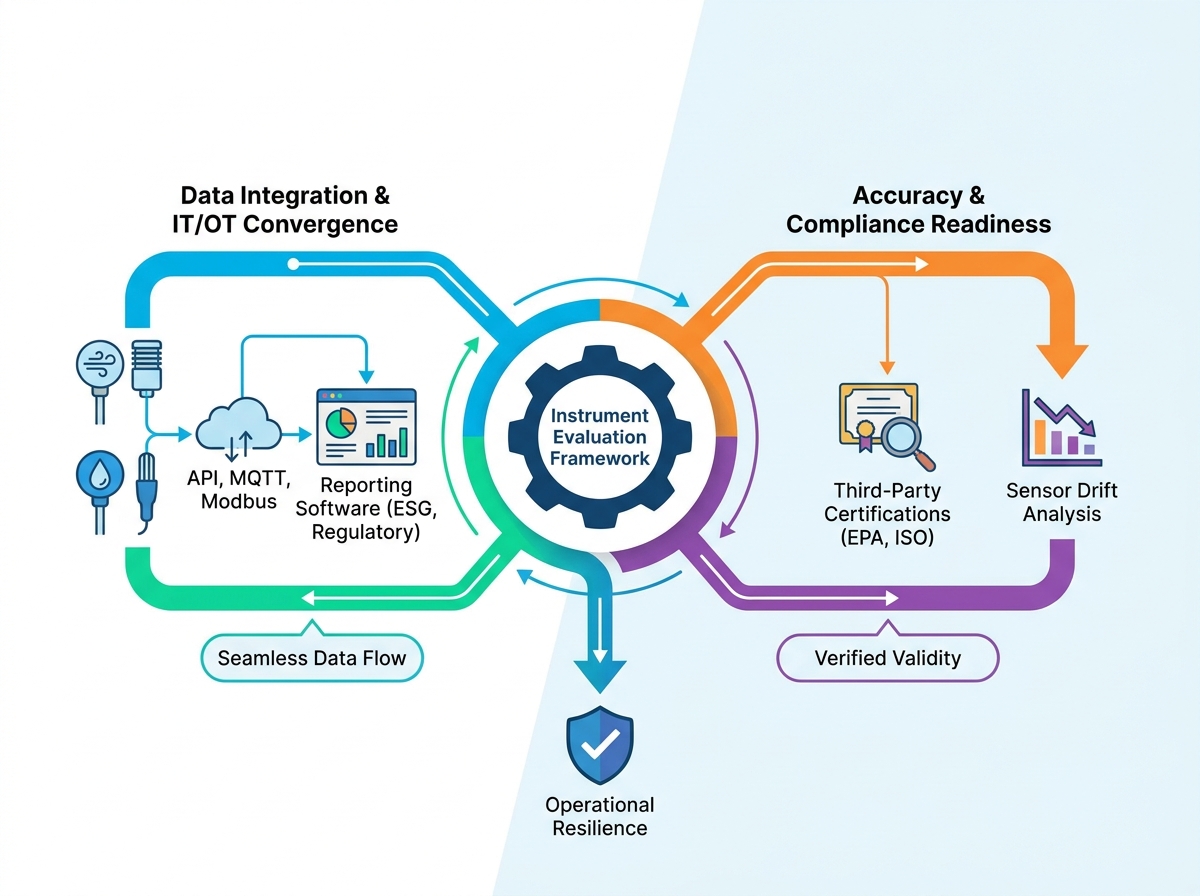
You must adopt an evidence-oriented standard when evaluating instrument accuracy. Never rely solely on manufacturer spec sheets or marketing brochures. You should always look for verified third-party certifications. Instruments carrying EPA equivalency, MCERTS, or specific ISO standards guarantee data validity. Auditors trust data generated by certified devices. Using uncertified equipment often renders your reports useless during an official compliance audit.
Evaluating sensor drift is equally important for maintaining long-term accuracy. Drift refers to a sensor losing its calibration baseline over time. High drift rates mean your instruments require much more frequent recalibration. This leads directly to increased operational downtime. You must interrogate vendors about the expected drift rate under your specific environmental conditions. Reliable environmental monitoring instruments maintain stable readings for extended periods, keeping your monitoring network active.
Modern hardware must communicate seamlessly across your network. You must ensure instruments support industry-standard communication protocols. Look for devices utilizing Modbus, SCADA, or MQTT protocols for reliable data transfer. Proprietary communication formats trap your data in isolated silos. Open API architectures allow your IT department to route field sensor data into centralized analytics platforms easily. This IT/OT convergence drives actionable intelligence across the enterprise.
The hardware must also feed easily into compliant reporting dashboards. Field data holds little value if engineers must export and format it manually. Your monitoring system should automate ESG and regulatory submissions seamlessly. When an inspector requests a quarterly emissions report, your software should generate it instantly from real-time database queries. Seamless integration eliminates human error and guarantees reporting consistency.
You must evaluate implementation reality against stated hardware specifications. Industrial environments punish fragile electronics relentlessly. You need to assess specific IP and NEMA ratings against your actual site conditions. A standard indoor sensor will fail rapidly in a corrosive chemical plant. Extreme temperatures, high humidity, and airborne dust degrade sensitive components quickly.
Assess the maximum and minimum ambient temperatures at the installation site.
Determine the presence of corrosive gases or saltwater spray.
Evaluate the potential for physical impacts or heavy vibration near the mounting location.
Select enclosures rated IP67 or NEMA 4X for severe outdoor deployments.
Deploying a new monitoring network carries significant logistical risks. Organizations often attempt massive, facility-wide deployments all at once. You should avoid these "big bang" deployments entirely. Start your implementation with a focused pilot test in a carefully controlled zone. A limited rollout lets your team identify integration bugs without disrupting the entire plant. You can test data flow, alarm triggers, and sensor stability on a small scale. Once the pilot proves successful, you can confidently scale the solution across the facility.
Calibration and maintenance lifecycles require careful logistical planning. You must identify exactly who performs routine calibration tasks. Determine whether your internal technicians handle this or if units require return-to-base factory servicing. Shipping instruments back to the manufacturer causes significant monitoring gaps. You must also calculate the physical lifespan of consumable sensor elements. Electrochemical cells often degrade physically over 12 to 24 months. Planning for these inevitable hardware swaps prevents unexpected monitoring blind spots.
Network connectivity failure represents a major risk for remote monitoring locations. Remote outposts often lack stable Wi-Fi or Ethernet connections. You must address this risk during the hardware selection phase. Deploy instruments featuring cellular or satellite backup communication modules. Furthermore, ensure remote sensors possess adequate edge-storage capabilities. If the network drops, the instrument must store data locally on internal memory. Once connectivity restores, the device automatically uploads the backlogged data, ensuring unbroken compliance records.
Evaluating the vendor ecosystem determines your long-term success. You must decide if the vendor provides merely a standalone instrument or a complete end-to-end solution. End-to-end providers supply the hardware, integration software, and ongoing maintenance contracts. This unified approach prevents finger-pointing between different software and hardware suppliers when systems fail. Dedicated solution providers often deliver smoother integrations and faster troubleshooting.
Global buyers must strictly ensure the vendor maintains localized support networks. When a critical emissions sensor fails, you cannot wait weeks for international shipping. You need rapid parts replacement available from regional distribution hubs. Local support teams also understand regional compliance standards better than overseas representatives. They help ensure your newly procured environmental monitoring instruments meet specific local municipal codes immediately upon installation.
Taking concrete next-step actions protects your investment before you sign a purchase order. You should actively demand these deliverables from shortlisted vendors:
Request a comprehensive site audit or physical feasibility study.
Demand a working proof-of-concept (PoC) demonstrating successful software integration.
Ask for documented mean-time-between-failures (MTBF) statistics from similar industry deployments.
Require a detailed onboarding and operator training schedule.
Procuring monitoring instruments serves as a strategic investment in compliance and operational resilience, not merely a hardware transaction.
Prioritize transparent data routing and robust integration capabilities over marginal improvements in baseline technical specifications.
Align your hardware choices with proven third-party certifications to guarantee undisputed data validity during regulatory audits.
Address remote connectivity challenges early by demanding edge-storage and cellular backup features.
Take immediate action to secure your facility's operational future. Download a detailed technical specification checklist to audit your current capabilities. Request a comprehensive vendor capability matrix to compare top-tier suppliers objectively. Schedule a direct consultation with a certified monitoring specialist today to map out your integration strategy.
A: Calibration frequency varies significantly by sensor type and operational environment. Most industrial sensors require calibration every 3 to 12 months. However, regulatory bodies often dictate mandatory calibration schedules. You must follow these legal requirements strictly, regardless of longer manufacturer claims, to maintain compliance.
A: Continuous instruments provide uninterrupted, real-time data streams via automated sensors. They trigger immediate alarms when thresholds breach. Active sampling requires physically drawing air or water into a medium, which operators then send to a laboratory for subsequent analysis. Sampling introduces time delays.
A: Yes, integration is usually possible. New instruments must support standard industrial protocols like Modbus or offer robust APIs. However, older legacy systems may struggle with modern data formats. You will likely require specialized middleware or gateway devices to bridge the communication gap.
A: You should specifically look for EPA reference or equivalent methods if operating in the US. Seek MCERTS certification in the UK and TÜV approval across Europe. General alignment with ISO 14001 standards also demonstrates a strong commitment to environmental management best practices.


