
Views: 0 Author: Site Editor Publish Time: 2026-10-05 Origin: Site


In highly regulated facilities, environmental monitoring is not just a quality check. It is a critical compliance mandate. You must maintain sterile conditions to prevent devastating contamination events. Transitioning from basic environmental surveillance to precision sampling demands robust instrumentation. You need equipment capable of processing larger volumes of air. The system must achieve this without compromising biological or particulate integrity. Relying on outdated units often causes severe testing bottlenecks.
A high air sampler accelerates data collection and improves statistical confidence. Processing air at rapid speeds minimizes production downtime and labor costs. This guide breaks down how to evaluate and select the ideal device. We will explore how you can implement the right sampler for your facility’s specific risk profile. You will learn key evaluation frameworks, regulatory standards, and practical strategies to upgrade your monitoring workflow.
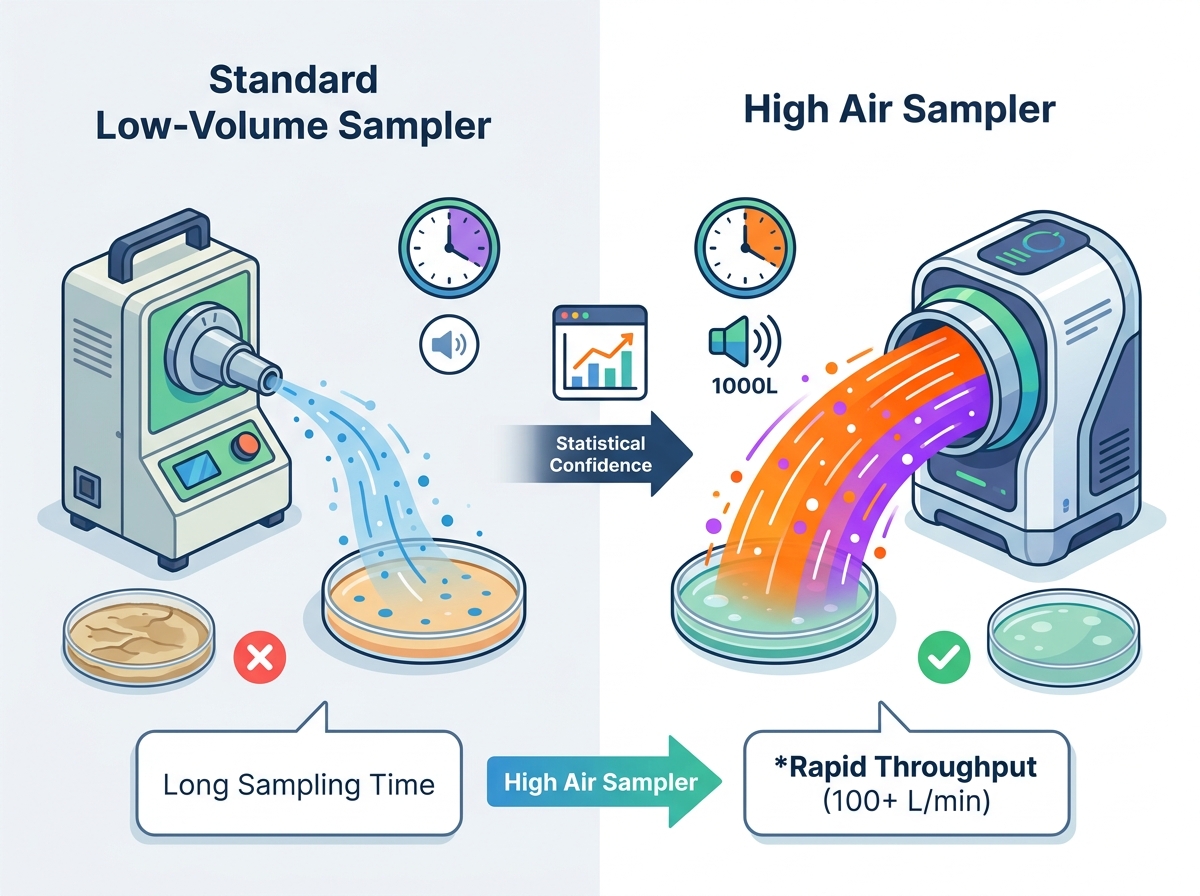
Throughput vs. Accuracy: High air samplers process air faster (often 100 L/min or more), significantly reducing the time required to meet ISO and USP volume requirements.
Physical & Biological Efficiency: The right device must balance impaction velocity—capturing viable microorganisms without causing desiccation or mechanical destruction.
Contextual Fit: Device selection depends heavily on the monitoring environment (e.g., cleanrooms, pharmaceutical manufacturing, or heavy industrial settings).
Many facilities face a common operational bottleneck during routine testing. Standard samplers often require excessive operational time to function effectively. Regulatory standards typically require capturing 1 cubic meter of air. This equals exactly 1,000 liters. Pulling this volume at lower rates leads to severe production delays. It also causes significant operator fatigue. Operators must stand fully gowned in sterile areas while waiting for machines to finish.
Standard passive monitoring methods rely on settling plates. These plates sit open for hours, hoping particles fall onto them. This passive approach lacks statistical rigor. Active air sampling forces specific volumes of air onto media. You gain precise, quantifiable data about your cleanroom air quality. Transitioning to active, high-volume methods represents a massive upgrade in environmental control.
The high-volume advantage changes this operational dynamic entirely. High air samplers process these standard volumes in a fraction of the time. You can conduct rapid sequential sampling across multiple cleanroom zones. Fast processing keeps pharmaceutical production lines moving efficiently. It reduces the time operators spend lingering in critical Grade A or Grade B spaces.
To achieve a successful deployment, you must look for clear success criteria. First, a reliable Air sampler for environmental monitoring minimizes total sampling time. Second, it ensures consistent flow rates. The motor must compensate regardless of filter thickness or agar plate resistance. Finally, the system must maintain a strict digital audit trail. Inspectors rely on this data to verify compliance. Properly deployed, these units transform environmental monitoring from a slow chore into a highly efficient process.
Choosing the right equipment requires a clear evaluation framework. You must understand flow rate dynamics to make an informed choice. Modern high-volume systems typically pull 100 to 200 liters per minute. We compare these directly against older 28.3 L/min units. Processing air at higher speeds drastically cuts cleanroom wait times.
Larger sampled volumes yield more representative data on airborne contamination levels. Statistical significance increases when you test higher air volumes quickly. You get a truer snapshot of real-time particle distribution. Transient contamination events often go unnoticed by slow samplers. A fast unit captures these events before they disperse.
However, high-volume flow introduces potential desiccation risks. Rapid air movement can cause rapid agar dehydration. Dried agar often results in false-negative microbial counts. Biological cells cannot form visible colonies on dried media. You must mitigate this by choosing hardware designed to protect moisture.
Use a structured decision matrix to guide your monitoring strategy. Retain low-volume samplers for prolonged continuous monitoring tasks. Upgrade to high-volume units for rapid, point-in-time sequential testing.
Table 1: Flow Rate Dynamics Comparison
Evaluation Feature | Standard Sampler (28.3 L/min) | High Air Sampler (100+ L/min) |
|---|---|---|
Volume Completion (1m³) | Approximately 35 minutes | 10 minutes or less |
Statistical Confidence | Lower for transient events | High due to rapid collection |
Best Application | Continuous background monitoring | Rapid sequential zone testing |
Desiccation Risk | Low | Moderate (requires optimized impaction) |
Evaluating your equipment ensures reliable biological data collection. You must assess the sampler's physical and biological collection efficiency. D50 resolution is a critical performance metric. It represents the aerodynamic diameter where 50% of particles are captured. The device must guarantee particles down to 1 micron are trapped. Impaction velocity plays a massive role here. If air moves too slowly, particles bounce away. If air moves too fast, viable cells rupture upon impact.
Microbes do not float naked in the air. They attach to skin flakes, dust, or water droplets. This means your sampler must capture these larger carrier particles effectively. A well-designed sampling head creates a laminar air flow path. It gently guides these carrier particles directly onto the agar surface. Poorly designed heads create turbulence, causing particles to miss the media entirely.
You must clarify whether the device handles viable or non-viable capabilities. Some units focus exclusively on particulate counting via laser sensors. Others are explicitly optimized for Air sampler microbiology. These rely on precise physical impaction onto agar plates. They capture living microbes for viable colony counts.
Exhaust filtration is another mandatory requirement for sterile environments. Ensure the device features an integrated HEPA-filtered exhaust system. Unfiltered exhaust can turn the sampler itself into a contamination source. Motors shed microscopic debris during operation. This is especially dangerous inside highly regulated ISO Class 5 environments.
Finally, assess construction material compliance thoroughly. Rigorous sanitization protocols demand robust materials. Look for 316L stainless steel enclosures. Stainless steel resists harsh cleaning chemicals and prevents rust. Any exposed plastics must be fully VHP-compatible. Vaporized hydrogen peroxide treatments will crack cheap plastics over time.
Regulatory alignment dictates your baseline equipment choices. You must meet specific biocontamination control guidelines to operate legally. ISO 14698 provides the foundational framework for evaluating physical and biological efficiency. Facilities also need strict USP <797> and <798> alignment. These chapters govern compounding environments and mandate sterile testing conditions.
Data integrity cannot be an afterthought during procurement. Evaluate the device's digital ecosystem for 21 CFR Part 11 readiness. Modern samplers must offer secure, unalterable data logging. They should include strict user access controls. Automated audit trails prove to inspectors who performed specific tests. They also record exactly when the operator ran the test.
Auditors frequently target data logs during inspections. They look for discrepancies in sample timing or flow volumes. Relying on paper records introduces human error. Technicians might write down the wrong time or forget to log a sample entirely. Digital systems eliminate this risk. They capture metadata in the background seamlessly. You generate comprehensive reports via a single button press.
Calibration tolerance directly impacts your biological sample accuracy. Air density variations affect volumetric flow during testing. Temperature and atmospheric pressure change constantly throughout the day. The best devices self-correct to maintain a constant volumetric flow rate. Built-in compensation sensors adjust the motor speed dynamically. This ensures your 1,000-liter sample remains exact regardless of environmental shifts.
Here are three best practices for maintaining data integrity:
Lock device settings using administrator passwords to prevent unauthorized flow rate changes.
Export sampling data to a centralized secure server immediately after each shift.
Validate the auto-compensation sensors quarterly against a certified environmental flow meter.
Deploying new equipment often reveals hidden operational challenges. The false-positive risk increases during rapid testing cycles. Improper operator handling during quick agar plate swaps negates sampler efficiency. If a technician accidentally touches the media, contamination occurs. You must train staff specifically on rapid exchange protocols. Operators must understand how to position their bodies. They should never block the aerodynamic intake of the unit.
Training plays a massive role in implementation success. Even the most advanced sampler cannot compensate for poor aseptic technique. Staff must practice loading and unloading plates in a biosafety cabinet first. They need to build muscle memory before working in Grade A spaces. Establish strict Standard Operating Procedures for routine maintenance as well. Clean the sampling head according to manufacturer guidelines after every shift.
You must also consider environmental limitations before purchasing. Specific sensor types struggle in harsh industrial conditions. High-humidity areas can cause false flow readings. Highly corrosive industrial environments degrade standard internal components rapidly. You must select specialized models built specifically for these extremes. Standard cleanroom units will fail in heavy industrial zones.
Forecasting maintenance realities prevents unexpected production downtime. Annual factory calibrations often require shipping units away. This leaves your quality team without critical monitoring tools for weeks. Field-calibration capabilities offer a strong alternative. On-site verification reduces logistical costs. It keeps your vital equipment inside the facility where it belongs.
Common mistakes during implementation include:
Failing to wear sterile gloves during rapid agar plate transfers.
Placing the sampler too close to return air vents.
Ignoring mechanical error alerts related to flow restriction.
Using media plates past their expiration date.
Purchasing the right sampler requires structured shortlisting logic. Prioritize manufacturers offering comprehensive validation support upfront. You need thorough Installation Qualification (IQ) documentation. Operational Qualification (OQ) and Performance Qualification (PQ) protocols are equally vital. These documents prove the equipment functions properly within your unique facility. Without them, you cannot legally use the data.
Always insist on trialing equipment before making a final decision. Environmental health and safety managers should demand on-site proof-of-concept testing. You must verify agar compatibility with your existing media supplier. Proprietary media cassettes lock you into expensive contracts. Open-source designs allow you to use standard plates.
Consider the long-term software licensing structure as well. Some manufacturers charge annual fees for basic data export features. Others include fully unlocked software upon purchase. Clarify these details during the trial phase. Ask the vendor about firmware updates and technical support availability. Reliable customer service matters just as much as hardware reliability.
Test the device battery life under actual shift conditions. A robust battery should easily last through a full day of sequential testing. You do not want machines dying mid-cycle. Do not rely solely on printed specification sheets. Reach out directly to discuss customized monitoring requirements. You can deploy a high air sampler tailored to your workflow. Real-world testing remains the only way to validate true performance.
High air samplers are substantial investments in operational efficiency. They deliver long-term regulatory peace of mind for quality assurance teams. Faster testing cycles protect your production timeline. They do this without sacrificing microbial accuracy or statistical confidence. Moving away from slow, outdated machinery streamlines your entire workflow.
Base your final decision on three critical factors. First, consider your specific microbiological standards. Second, evaluate your exact cleanroom classification and exhaust needs. Third, weigh your facility's internal data integrity requirements. Balancing these variables ensures you select a highly capable monitoring tool.
Take the next step toward better environmental control today. Consult with an environmental monitoring specialist immediately. Request an application-specific demo to validate performance in your facility. Seeing the equipment operate in your own cleanroom removes all guesswork. Make informed choices to safeguard your sterile manufacturing environments.
A: Typically, these devices operate between 100 L/min and 180 L/min. They are specifically designed to complete a standard 1,000-liter sample in 10 minutes or less. This significantly reduces production downtime compared to older models.
A: These devices use precision-machined sampling heads and optimized impaction velocities. The calibrated flow ensures microorganisms are securely trapped on the agar surface before the media dries out, preventing false-negative test results.
A: It heavily depends on the specific model. Some units require proprietary media cassettes. Others feature adjustable spring mechanisms designed to seamlessly accommodate standard 90mm or 55mm contact plates, offering greater consumable flexibility.
A: The industry standard requires an annual recalibration. However, heavily used units operating in high-compliance environments often demand semi-annual verification. You should periodically check performance against a certified master flow meter.


