
Views: 0 Author: Site Editor Publish Time: 2026-10-10 Origin: Site


Relying entirely on third-party labs creates a massive operational bottleneck for cultivators and processors. You send off samples, wait several days for results, and watch your margins shrink while decision-making stalls. Fast-moving markets do not wait for delayed lab reports. This is where an in-house THC Analyzer changes the game completely. It acts as a rapid potency verification tool. It bridges the critical gap between daily cultivation management and final compliance testing.
You get actionable data immediately. This allows you to steer crops and optimize harvests on the fly. However, choosing the right equipment requires careful consideration. You must understand the underlying technology driving these devices. You also need to know acceptable accuracy variances and ongoing operational expenses. In this guide, we will explore how these analyzers function. We will also help you determine the best hardware fit for your facility.
A THC analyzer provides rapid, on-site quantification of cannabinoids, primarily using either spectroscopy (NIR) or chromatography (HPLC/GC).
In-house testing does not replace certified compliance labs; it serves as a process-control tool for pheno-hunting, harvest timing, and formulation.
When selecting a THC potency tester for flower, sample homogeneity and moisture content are the biggest variables affecting accuracy.
The best at home THC potency tester or boutique-scale device prioritizes ease of use and non-destructive testing, while commercial facilities require higher throughput and calibration rigor.
Outsourcing all potency tests creates severe financial and operational drags. Facilities often pay fifty to one hundred dollars per single sample. Multiply this across hundreds of phenotypes, and your R&D budget vanishes quickly. Furthermore, commercial labs usually require three to seven days to return results. This delay stalls supply chains. It also prevents extractors from moving forward into production phases. You lose money every extra day product sits in quarantine.
Successful in-house testing solves these problems by providing immediate data. Cultivators use this real-time feedback for precise crop steering. They can pinpoint the exact day a plant reaches peak potency. Processors use it to prevent failed compliance batches. If an extraction run tests too hot, they can dilute it immediately. Breeders rely on rapid testing to isolate top phenotypes during large-scale hunts.
However, we must maintain strict transparency regarding equipment limitations. In-house analyzers are strictly for internal R&D and QA/QC processes. They do not generate regulatory Certificates of Analysis (COAs). You still need third-party labs for final compliance testing. The true value of internal analysis lies in process control. It ensures you never fail a final compliance test because you already know your internal numbers.
Understanding internal testing requires a look at the underlying science. Different devices use vastly different technologies to measure cannabinoids. We can break these down into three main categories.
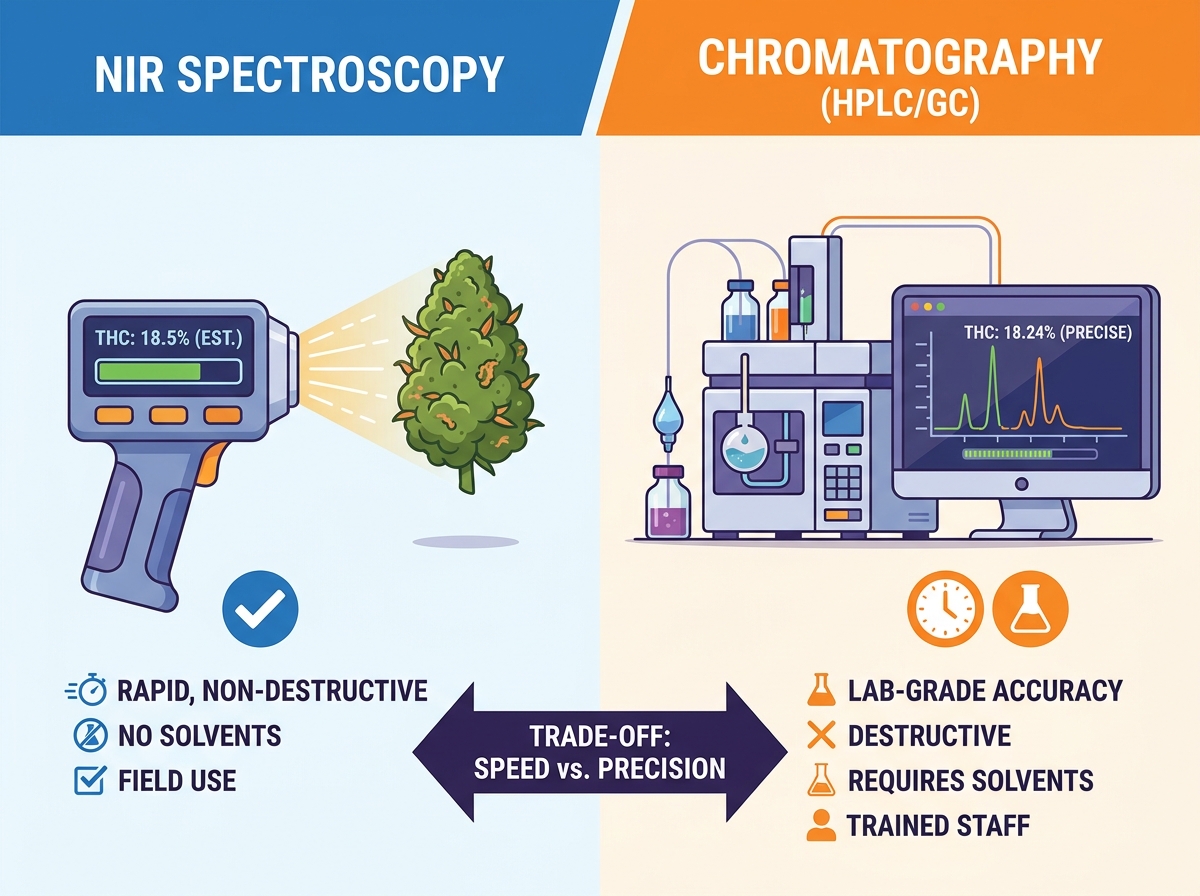
NIR spectroscopy uses light waves to analyze plant material. The device shines near-infrared light through your sample. Different chemical compounds absorb specific wavelengths of light. The machine measures the resulting absorption levels to identify cannabinoid signatures.
This method offers several distinct advantages. It is incredibly fast. Scans usually finish in under two minutes. Testing is often completely non-destructive. You do not need hazardous chemical solvents. However, NIR has drawbacks. It relies heavily on the vendor's machine-learning database. If your specific strain genetic profile is missing from their database, accuracy drops significantly.
High-Performance Liquid Chromatography (HPLC) and Gas Chromatography (GC) separate chemical compounds. They do this in either a liquid or gas state. This separation allows the machine to measure precise concentrations of individual molecules.
Chromatography remains the absolute gold standard for accuracy. Certified labs exclusively use this technology. Unfortunately, these systems require a massive upfront investment. You must purchase hazardous solvents. The process destroys the sample entirely. Running these machines also requires hiring trained lab technicians. They are rarely practical for small operators.
Emerging portable technology relies on specialized sensors. Some devices function similarly to breathalyzers. Others use basic handheld electrochemical nodes. These options offer supreme portability. You can carry them directly into the grow room.
Their current accuracy thresholds remain lower than desktop units. They work well for rough estimates. They struggle to differentiate closely related minor cannabinoids. Industry experts view them as screening tools rather than precise analytical instruments.
Testing different substrates requires entirely different approaches. The physical makeup of your sample dictates the best testing method.
Flower is notoriously difficult to test accurately. Trichome distribution varies wildly across a single plant. The top colas measure differently than lower branches. Moisture content also heavily skews readings. Water weight dilutes the concentration of cannabinoids per gram. Selecting a THC potency tester for flower means you must account for these variables meticulously.
Sample preparation methods directly impact your results. Destructive methods require grinding and homogenizing the buds. This approach blends the trichomes evenly. It generally provides a more accurate average reading. Non-destructive methods involve scanning whole buds. This preserves your product for sale. However, scanning one side of a dense nug might yield lower results than scanning the trichome-heavy interior.
Extracts and infusions present different challenges. Liquids, oils, and concentrates possess high density and viscosity. You cannot test distillate using a machine calibrated for dry herbs. These materials require different sensor calibrations. Often, they need entirely different testing modules or sample cuvettes. Light passes through oil differently than it reflects off plant matter.
Buyers must match their device to their primary substrate. Do not buy a flower-first scanner if you primarily process concentrates. Verify hardware capabilities before committing. Many vendors sell interchangeable modules for different material types.
The market divides roughly into two main categories of equipment. Understanding your operational scale helps narrow down the choices.
This category targets homegrowers, micro-cultivators, and boutique breeders. These users process smaller volumes. They value simplicity over extreme precision.
Prosumer devices feature heavy smartphone app integration. They require minimal sample preparation. The upfront hardware costs remain highly accessible. These machines allow breeders to map basic genetic traits quickly.
The trade-off comes in the form of higher variance. You can expect accuracy gaps of +/- 2% to 3% compared to HPLC lab results. This variance makes them unsuitable for strict compliance formulations. Finding the Best at home THC potency tester means accepting this variance in exchange for speed and convenience.
This tier targets licensed producers, extraction labs, and multi-state operators. These facilities run hundreds of samples weekly. They require robust data management and high throughput.
Commercial devices offer API integration directly into seed-to-sale tracking software like METRC. They provide broad cannabinoid profiling. You receive data on CBD, CBG, and various minor cannabinoids simultaneously. The hardware runs continuously without overheating.
These machines demand strict standard operating procedures (SOPs). They require regular hardware calibration against certified reference materials. The initial capital expenditure is significantly higher. However, the cost per test drops drastically at volume.
Buying the hardware is only the first step. Operating an analytical device introduces ongoing realities you must manage.
Software and subscription fees often surprise new buyers. Many NIR devices rely on cloud-based analysis platforms. The machine captures the light spectrum, but the cloud interprets it. Vendors charge monthly fees for access to these updated machine-learning databases. Without the subscription, the hardware becomes essentially useless. You must account for these recurring costs in your budget.
Calibration realities dictate your long-term success. An analyzer is only as good as its underlying reference model. Drift occurs over time. Dust settles on lenses. Internal lamps degrade. You must periodically cross-reference your in-house results against third-party HPLC labs. If your machine says 22% and the lab says 18%, you must recalibrate your internal device immediately. Routine calibration maintains testing integrity.
Training and SOPs represent the biggest risk factor. User error ruins data constantly. A device is useless if staff prepare samples inconsistently. If one technician grinds flower fine and another leaves it chunky, your results will swing wildly. Emphasize the need for vendor-provided training. Document every step of your preparation process clearly. Consistency in prep equals consistency in data.
Selecting the right equipment requires mapping your features to your desired outcomes.
If your primary goal involves harvest timing, prioritize speed. You want non-destructive flower testing. You need to walk through the rooms, scan buds, and leave them intact. If your goal revolves around product formulation, prioritize precise extraction measurement. You need devices capable of reading dense distillates without large margins of error.
Technology Type | Best Suited For | Sample Preparation | Relative Accuracy Level |
|---|---|---|---|
NIR Spectroscopy | Harvest timing, Pheno-hunting | Non-destructive or coarse grind | Moderate to High |
HPLC / GC | Final compliance, R&D labs | Destructive, solvent-based | Very High (Gold Standard) |
Portable Sensors | Quick field estimates | Varies by device model | Low to Moderate |
You must calculate basic return on investment properly. Use a simple formula. Subtract your internal testing consumable costs from your monthly outsourced testing budget. Compare this monthly savings against the upfront equipment cost. Most commercial facilities see full payback within six to eight months. Homegrowers might take longer depending on their testing frequency.
For your next steps, always recommend asking vendors for a trial period. Send known samples to test their hardware accurately. If you have a recent COA for a batch, test that same batch on their demo unit. Compare the variance before committing to a purchase.
An in-house analyzer empowers cultivators and processors with real-time data. It eliminates the blind spots caused by outsourcing delays. However, success requires realistic expectations regarding accuracy versus convenience. No portable scanner will perfectly match a million-dollar lab setup. They exist to guide your internal processes, not to replace regulatory testing.
The right device acts as a reliable operational compass. It saves immense amounts of money in the long run. It streamlines your time-to-market by allowing instant decision-making. You stop guessing and start measuring.
Ready to upgrade your quality control process? Review your substrate needs, calculate your testing volumes, and explore our specialized hardware solutions. Contact a specialist today to find the perfect THC Analyzer tailored to your facility.
A: No. Handheld units serve as rapid screening tools. They typically carry an acceptable margin of error around 2% to 3%. Lab-grade HPLC machines offer supreme accuracy down to decimal fractions. You should use handhelds for internal process control, while relying on labs for compliance.
A: Potency testers are highly specific to cannabinoids. They measure molecular compounds like CBD and CBN. Contaminants such as pesticides, molds, or heavy metals require entirely different analytical equipment, usually mass spectrometry systems found only in certified labs.
A: It depends on the methodology. Non-destructive whole-bud scanning leaves the flower perfectly intact for sale. However, destructive homogenization requires grinding the flower into powder for a more uniform reading. Both methods exist within NIR technology ecosystems.
A: Standard industry practice suggests verifying calibration monthly against a known third-party lab sample. Additionally, many NIR devices rely on frequent vendor software updates to refine their machine-learning models. Always recalibrate when changing substrate types.


