
Views: 0 Author: Site Editor Publish Time: 2026-10-20 Origin: Site


Facility managers and EHS directors face immense regulatory pressure today. Environmental agencies worldwide enforce increasingly strict limits on particulate matter (PM) emissions. You simply cannot afford blind spots in your facility's exhaust gas streams. A Stack Dust Tester serves as an essential diagnostic and compliance tool. It precisely quantifies particulate concentrations inside industrial stacks. We use these instruments to track compliance and prevent hazardous environmental releases. This article moves beyond basic definitions. We provide a comprehensive framework to help you evaluate, select, and implement the right testing equipment. You will discover how to match testing technologies to specific industrial applications. We aim to equip you with actionable insights to optimize your emission control strategy effectively. Navigating these complex equipment choices ensures your plant remains both legally compliant and operationally efficient.
Stack dust testers measure particulate emissions to ensure alignment with stringent local and international environmental standards (e.g., EPA, ISO).
Choosing between portable testing kits and Continuous Emission Monitoring Systems (CEMS) depends on facility size, regulatory mandates, and budget.
Accurate testing relies on isokinetic sampling; equipment lacking automated flow-rate adjustments risks severe data skew.
Reliable emission data forms the backbone of modern industrial operations. You need accurate measurements to protect your bottom line. A robust testing strategy delivers value far beyond basic compliance.
Failing an emission audit carries severe financial and legal ramifications. Regulators can impose heavy fines or mandate immediate facility shutdowns. You must maintain a verifiable audit trail to defend your operations. Accurate testing provides this exact necessary documentation. It proves your operations remain strictly within permitted limits during surprise regulatory inspections. We see many facilities use this empirical data to preemptively address compliance risks. Documented compliance also lowers insurance premiums in many industrial sectors.
Think of emission data as an invaluable operational baseline. It is definitely not just a regulatory checkbox. Sudden spikes in dust concentration often signal underlying mechanical issues immediately. They can indicate early baghouse filter tearing or wet scrubber inefficiencies. Catching these emission spikes early prevents catastrophic equipment breakdowns. You save significant money by scheduling proactive maintenance before major equipment fails entirely. Plant engineers rely on this data to fine-tune combustion processes for maximum fuel efficiency.
You must use standardized methodologies to validate your collected data. Frameworks like EPA Method 5 or ISO 9096 provide rigid, proven testing protocols. Environmental regulatory bodies require strict adherence to these specific standards. Using compliant methodology ensures agencies accept your reporting without any question. Reliable data protects your corporate reputation and builds vital trust among local communities. Transparent reporting also satisfies environmental requirements demanded by modern investors.
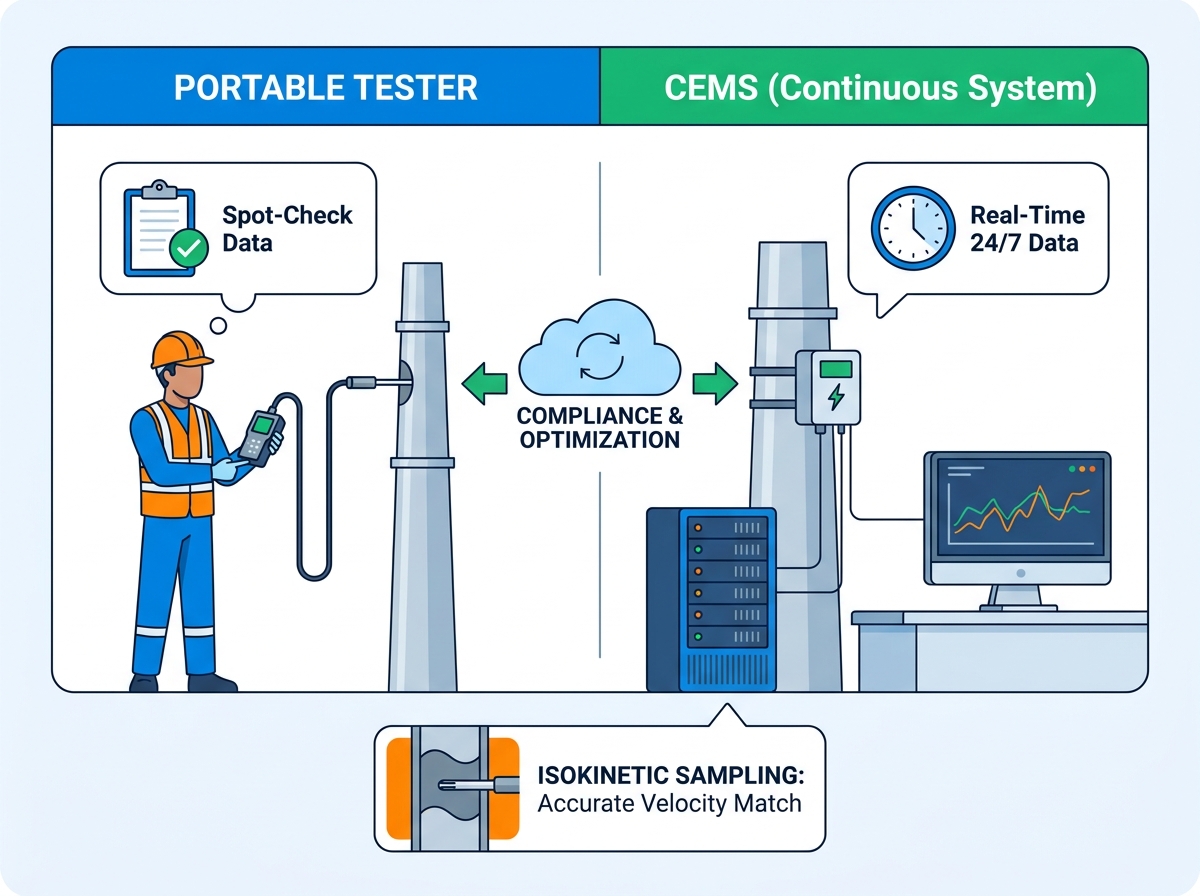
Selecting the right monitoring approach depends on your specific operational needs. You must weigh technical requirements against regulatory demands carefully. We generally categorize testing equipment into two main groups.
Portable units offer immense flexibility for environmental monitoring teams. You can easily move them between different emission points across a large facility.
Use Case: Spot-checking, pre-compliance audits, and facilities requiring only periodic regulatory reporting.
Pros: They require a much lower initial capital expenditure compared to fixed systems. You gain the flexibility to test multiple stacks across different plant sites. This versatility makes them perfect for internal auditing teams.
Cons: Manual setup requires highly trained personnel for every single test. The equipment only provides snapshot data rather than a continuous emission profile. You might miss transient emission spikes that occur between testing intervals.
Continuous systems integrate directly into your exhaust infrastructure. They remain permanently installed to track data around the clock.
Use Case: Heavy industries like cement manufacturing, power generation, and metallurgy. These specific sectors face strict mandates for 24/7 real-time data logging.
Pros: CEMS completely eliminates manual sampling errors and human inconsistencies. The system provides an uninterrupted, real-time stream of compliance data. Operators receive instant alarms if emissions exceed permitted thresholds.
Cons: You will face a very high upfront capital investment for hardware and installation. These complex systems also demand rigorous, strictly scheduled maintenance routines. You must manage large volumes of digital data securely.
System Comparison Summary
Feature | Portable Testers | Continuous Systems (CEMS) |
|---|---|---|
Data Collection | Periodic periodic snapshots | 24/7 real-time logging |
Initial Investment | Low to moderate | Very high |
Mobility | High (multi-stack capable) | Fixed permanent installation |
Personnel Need | Requires trained manual operators | Requires automated maintenance teams |
Not all monitoring devices deliver the same level of measurement accuracy. You must evaluate internal components carefully before purchasing. Pay close attention to these four critical technical pillars.
Isokinetic sampling is absolutely non-negotiable for accurate particulate measurement. The velocity of gas entering the sampling nozzle must perfectly match the stack gas velocity. If these velocities differ, severe sizing and concentration biases will occur. Lighter particles might bypass the nozzle entirely if suction is too weak. Heavier particles could be forced inside artificially if suction is too strong. Always look for equipment featuring automated isokinetic control mechanisms. They adjust internal flow rates dynamically to maintain perfect velocity alignment. This automation removes dangerous human error from complex flow calculations.
Industrial stack environments are incredibly harsh and unforgiving. Your testing equipment will face corrosive gases, extreme temperatures, and high moisture levels daily. Cheap component materials degrade quickly under these punishing conditions. Evaluate the internal construction materials of probes and sensors thoroughly. We highly recommend titanium or heated stainless steel components. These robust materials withstand aggressive exhaust streams without degrading over time. Investing in highly durable materials prevents premature equipment failure and costly emergency replacements.
Modern environmental compliance relies heavily on secure software interfaces. Assess the data management capabilities of any prospective testing device carefully. You need highly secure, tamper-proof data logging to satisfy strict regulatory auditors. Check if the device software offers direct export to standard compliance reporting formats. Real-time remote monitoring is another excellent, highly sought-after feature. It allows your EHS team to track live emissions from a central control room. This connectivity enables rapid response to any sudden process anomalies.
Even the best equipment experiences measurement accuracy drift over time. Routine calibration ensures your emission data remains completely legally defensible. Scrutinize how easily technicians can calibrate the testing unit on-site. Complex, convoluted calibration processes increase facility downtime significantly. They also drive up your ongoing operational and maintenance costs. Choose devices offering straightforward, user-friendly calibration procedures. Many modern testers include automated self-calibration routines to simplify this critical maintenance step safely.
Even premium equipment fails if operators use it incorrectly. We see many facilities stumble during the initial implementation phase. Understanding common technical pitfalls helps you avoid costly operational errors.
High moisture content in exhaust gases presents a major testing challenge. Condensation can easily form inside cold, unheated sampling lines. This unwanted moisture traps dust particles and skews particulate weights drastically. You must prevent any condensation to ensure accurate mass readings. Always use properly heated sampling probes and transfer lines. They keep the gas temperature safely above the dew point during extraction. Failing to manage moisture invalidates the entire testing procedure instantly.
Operators must carefully select the correct nozzle size for current flow conditions. Using an incorrect nozzle size guarantees a completely failed test. It physically disrupts the vital isokinetic conditions we discussed earlier. Your testing team must accurately measure the stack gas velocity first. They can then select the exact nozzle diameter required for that specific flow. This careful matching process prevents skewed concentration data entirely. Regular cross-checking of nozzle diameters before testing is a critical industry best practice.
Advanced technology cannot replace human expertise entirely. Even the most sophisticated portable testing unit requires skilled, knowledgeable handlers. Highly trained personnel must position the sampling probes correctly within the stack cross-section. They need deep aerodynamic knowledge to interpret complex flow dynamics accurately. Do not underestimate the immense value of comprehensive operator training. It is absolutely crucial for gathering reliable, legally compliant data. Invest heavily in continuous education for your environmental monitoring team.
Many facility managers mistakenly view CEMS as completely autonomous systems. They fall into the dangerous 'set it and forget it' trap. Continuous systems still require regular, highly specific human intervention. You must perform routine filter changes to prevent physical blockages. Internal sensors require frequent cleaning to maintain their baseline accuracy. Furthermore, environmental agencies mandate periodic third-party validation to confirm CEMS reliability. You must establish a proactive maintenance schedule to keep these systems fully operational.
Choosing the right equipment partner determines your long-term compliance success. You must follow a highly structured evaluation process. Use these four essential steps to narrow down your vendor options effectively.
Step 1: Map to Local Regulations. Identify the specific methodologies required by your governing environmental agency. Note any unique requirements for fine particulates like PM10 and PM2.5. Your chosen equipment must meet these exact legal standards perfectly. Mismatched equipment leads to rejected compliance reports.
Step 2: Assess Internal Capacity. Determine your in-house technical capabilities honestly and objectively. Do you have the necessary technical expertise to maintain complex testing equipment? If not, hiring a turnkey third-party testing service might prove more reliable. Outsourcing often reduces the heavy burden on your internal maintenance teams.
Step 3: Evaluate Vendor Support. Prioritize manufacturers or service partners offering robust local support. Look for guaranteed calibration turnaround times and dedicated repair technicians. Demand clear Service Level Agreements (SLAs) before signing any contracts. Consider reading more about us to understand what strong vendor support truly looks like in practice.
Step 4: Request Proof of Concept. Never buy a high-investment monitoring system blindly. Demand a comprehensive site survey and physical demonstration first. This identifies specific challenges like awkward stack access or highly variable flow rates early. Solve these site-specific problems confidently before finalizing any equipment purchase.
A reliable testing system represents a highly critical operational investment. It guarantees both strict legal compliance and deep operational transparency. You simply cannot afford to guess when it comes to industrial particulate emissions. Accurate data protects your facility from severe regulatory penalties while optimizing internal processes.
The right equipment choice always balances initial upfront costs with long-term measurement reliability. Prioritize testing units offering highly durable materials, automated isokinetic controls, and verifiable data accuracy. Whether you choose portable spot-checking or continuous monitoring, proper technical implementation remains paramount to your success.
Do not attempt to navigate complex environmental regulations completely alone. We highly encourage you to contact us to consult with an emission control specialist today. You can request a thorough technical assessment of your facility to pinpoint your exact stack monitoring needs.
A: Isokinetic sampling ensures the velocity of gas entering the testing nozzle perfectly matches the actual exhaust gas velocity. This alignment is crucial because it prevents artificial sizing biases. Without it, lighter particles might bypass the probe, while heavier ones are forced in, skewing your particulate profile completely.
A: You should typically calibrate your testing equipment before each major testing cycle. Specific EPA or ISO guidelines often mandate rigorous, structured calibration schedules. Always follow the manufacturer's specific recommendations to ensure your gathered data remains legally defensible during regulatory audits.
A: Yes, modern testing devices can measure both coarse and fine particulates simultaneously. However, they must be equipped with the correct physical impactors or cyclonic separators. These internal components physically separate the particulate fractions based on their aerodynamic diameter before the actual measurement occurs.
A: An opacity monitor simply measures how much light the exhaust gas blocks. It uses this light blockage as a rough visual proxy for dust levels. In contrast, a dust tester physically extracts the gas. It precisely measures the actual physical mass and exact concentration of the particulates present.


