
Views: 0 Author: Site Editor Publish Time: 2026-10-15 Origin: Site


Fugitive emissions create severe risks across industrial environments. They drive substantial product loss. They also introduce extreme safety hazards. Furthermore, regulatory bodies levy massive penalties for environmental non-compliance. You simply cannot afford undetected leaks. To combat this, the Cooled OGI Camera emerges as the supreme technical standard. Engineers specifically design it for optical gas imaging. It visualizes microscopic hydrocarbon and VOC leaks effortlessly. Alternative technologies routinely miss these small traces.
This guide gives maintenance leads, HSE directors, and plant managers a clear operational framework. You will learn to evaluate, price, and deploy these advanced systems. We will show you proven methods to guarantee regulatory compliance. You will also discover strategies to maximize your return on investment. Taking proactive steps now prevents catastrophic facility failures tomorrow.
Cooled OGI cameras use an integrated cryocooler to achieve unmatched thermal sensitivity, making them mandatory for strict regulatory compliance (e.g., EPA OOOOa) and detecting low-flow VOC/hydrocarbon leaks.
While a higher initial investment than uncooled alternatives, the ROI is realized through immediate leak mitigation, recovered product, and avoided regulatory fines.
Buyers must choose between continuous automated monitoring (Fixed OGI) and manual inspection rounds (Handheld/Portable), depending on site topography and risk profile.
Factoring in intrinsic safety certifications (ATEX/IECEx) and ongoing cryocooler maintenance is critical for calculating true Total Cost of Ownership (TCO).
Traditional leak detection and repair (LDAR) methods present massive logistical hurdles. Standard sniffers rely on Method 21 protocols. They remain incredibly slow. They require intense manual labor. Technicians must walk directly up to dangerous equipment. They place probes mere inches from suspected leak sources. This exposes workers to toxic environments. It also means surveying a large facility takes weeks. Labor costs skyrocket. You lose valuable time identifying critical failures.
The cooled advantage completely changes this dynamic. These cameras incorporate a miniature Stirling cryocooler. This mechanical device drops the internal sensor temperature to roughly 70 Kelvin (-203°C). This extreme cold effectively eliminates background thermal noise. The sensor achieves ultimate sensitivity. We refer to this as a high Noise Equivalent Temperature Difference (NETD). The internal detector specifically targets the Mid-Wave Infrared (MWIR) spectrum. This spans the 3 to 5 μm wavelength range. This band represents the exact absorption frequency for most critical hydrocarbons. Methane, benzene, and propane absorb infrared energy heavily here.
When gas escapes, it absorbs the background infrared energy. The chilled sensor detects this minute energy shift. It translates the absorption into a visible cloud on the screen. The success criteria become undeniable. Operators visualize leaks unambiguously. They stay at perfectly safe distances. They scan hundreds of components hourly. You drastically reduce inspection times. Simultaneously, you increase safety margins across the entire plant.
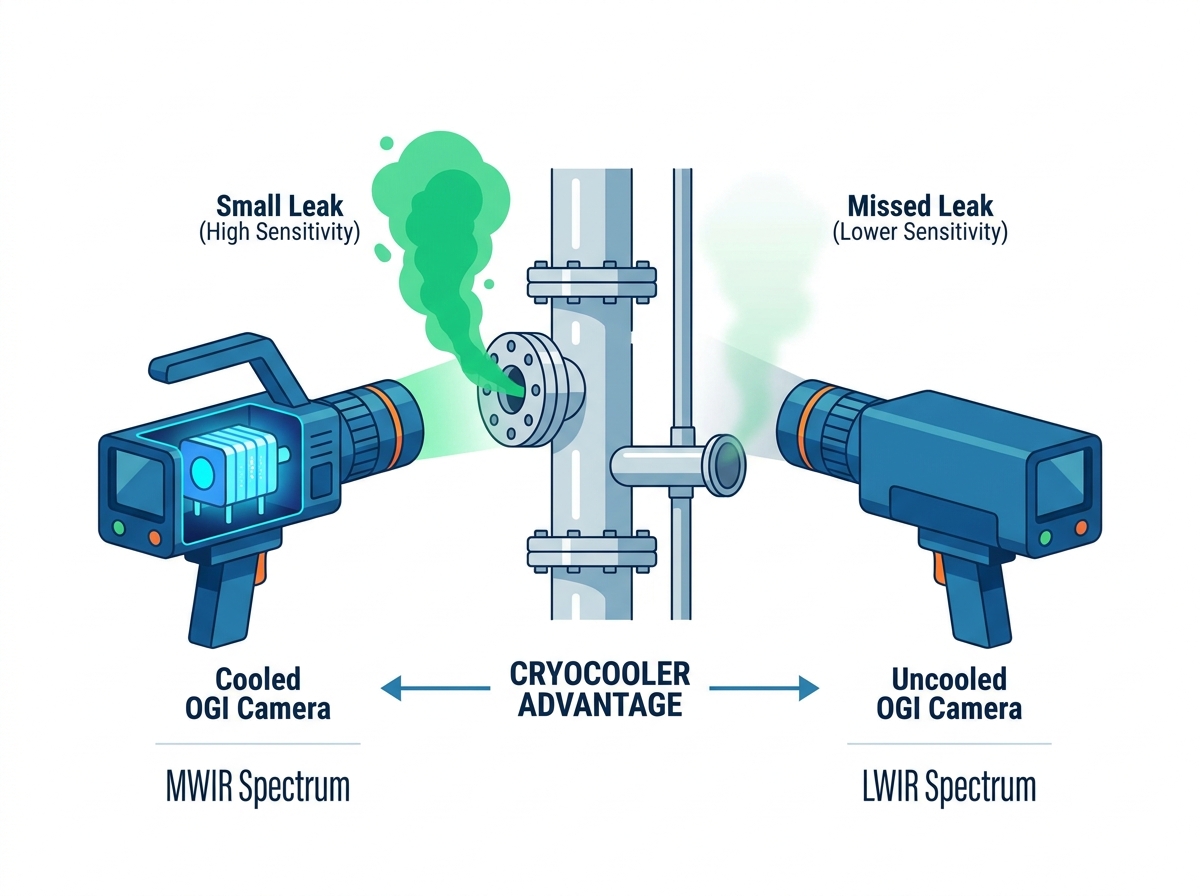
You must clearly delineate the boundary between available solution categories. Uncooled cameras use standard microbolometer technology. They operate at ambient room temperatures. They work well for general thermal inspections. However, they struggle in specialized gas detection roles. Validating your specific buyer need prevents costly mistakes.
Performance varies wildly between the two designs. Cooled cameras detect significantly smaller leaks. They perform flawlessly at much greater distances. Their high NETD catches minor wisps of escaping gas. Uncooled models lack this raw sensitivity. They routinely fail when gas concentrations remain low. They also struggle when the temperature difference (delta-T) between the gas and the background is minimal.
You must transparently address maintenance realities. Cryocoolers contain precision moving parts. They have a finite mechanical lifespan. You can typically expect 10,000 to 13,000 operational hours. Once the cooler wears out, you must send the unit for factory servicing. Uncooled cameras feature solid-state construction. They remain entirely maintenance-free regarding cooler mechanics.
The final verdict depends entirely on your compliance mandate. You can accept the limitations of uncooled cameras for basic, non-regulatory checks. However, environmental regulations like EPA OOOOa demand absolute certainty. When compliance dictates extreme sensitivity, procuring the Best cooled ogi camera becomes completely non-negotiable. You cannot compromise on detection capability.
Physical plant layout heavily dictates your ideal form factor. Labor availability also drives this critical implementation choice. You must align the hardware style to your daily operational realities.
Handheld and portable units dominate routine LDAR sweeps. They suit massive, sprawling facilities perfectly. Technicians carry them across miles of pipelines. Ergonomics play a massive role here. A well-balanced camera prevents operator fatigue. Extended battery life keeps inspectors moving through long shifts. High-definition viewfinders allow operators to spot faint plumes despite harsh sunlight glare.
Conversely, some environments demand a different approach. Offshore rigs and remote compressor stations often lack daily staff. These high-risk areas benefit immensely from the automated approach. A robust Fixed OGI camera provides uninterrupted oversight. It mounts securely on heavy-duty Pan-Tilt (PTZ) mechanisms. It sweeps pre-programmed paths continuously.
You integrate these fixed video feeds directly into your plant DCS or SCADA systems. Advanced analytics software monitors the stream. It triggers automated leak alarms instantly upon gas detection. You completely remove reliance on manual labor. You achieve true 24/7 continuous monitoring.
Feature | Handheld / Portable Units | Fixed OGI Camera Systems |
|---|---|---|
Primary Use Case | Routine LDAR sweeps across large facilities | 24/7 monitoring of high-risk or unmanned zones |
Labor Requirement | High (Requires trained thermographers) | Low (Automated integration into SCADA) |
Coverage Area | Unlimited (Mobile across entire plant) | Restricted to PTZ line-of-sight |
Key Strengths | Flexibility, ergonomic design, battery independence | Continuous alarming, removes workers from danger |
Operating in hazardous oil and gas environments requires extreme caution. A single spark can trigger a catastrophic explosion. You must evaluate equipment strictly on security and compliance dimensions. Standard electronics have no place in a refinery.
You must understand the necessary intrinsic safety ratings. Regulatory bodies define hazardous areas meticulously. Equipment must prove it will not ignite surrounding atmospheric gases.
ATEX: The European regulatory framework for explosive atmospheres.
IECEx: The international certification standard for hazardous location equipment.
Class 1 Div 1: North American standard for areas where explosive gases exist under normal operating conditions.
Class 1 Div 2: Areas where explosive gases exist only under abnormal conditions (like a leak).
Implementation risks rise sharply when ignoring these ratings. Beware of non-certified cameras. Using standard equipment in Zone 1 or Zone 2 areas requires complex "hot work permits". You must deploy continuous gas monitors alongside the camera operator. This wastes tremendous time. It introduces unnecessary administrative burdens.
Explosion-proof enclosures offer one workaround. Facilities often use them to house fixed uncertified cameras. However, this creates a distinct trade-off. These specialized steel housings add significant weight. They demand heavier mounting hardware. They greatly increase the physical footprint of the installation.
Zone Classification | Presence of Explosive Gas | Equipment Requirement |
|---|---|---|
Zone 0 | Present continuously or for long periods | Category 1G (Extremely high protection) |
Zone 1 | Likely to occur in normal operation occasionally | Category 2G (High protection, typical for OGI) |
Zone 2 | Not likely to occur, or only for short periods | Category 3G (Normal protection) |
Moving from technical evaluation to commercial procurement requires a structured shortlisting logic. You must deeply understand the financial implications of this advanced technology.
Break down the initial capital expenditure (CAPEX) carefully. The quantum sensor itself drives the bulk of the cost. Specialized germanium lens configurations add further expense. You also pay for integrated reporting software packages. When assessing the Cooled ogi camera price, you will see a premium figure. Maintenance factors also influence your budget over time. Annual calibration ensures regulatory measurement accuracy. Cryocooler replacement cycles occur every few years. You must also fund continuous operator training. ITC thermography certification ensures your staff interprets the infrared data correctly.
You justify this ROI through hard operational metrics. Calculate payback periods based on saved natural gas. Recovered product directly offsets the equipment cost. More importantly, early leak detection prevents emergency operational shutdowns. Avoiding just one day of plant downtime often pays for the entire camera system.
Determine your procurement next steps wisely. When evaluating an OGI camera for sale, scrutinize the vendor closely. Review the warranty terms thoroughly. Ask about loaner programs during factory servicing. A loaner camera keeps your LDAR schedules on track. Demand robust post-sales technical support. Do not simply look for a generic Cooled ogi camera for sale on the secondary market. Used equipment often harbors worn cryocoolers. You need a trusted partner who guarantees long-term operational reliability.
A cooled optical gas imaging system transcends basic inspection duties. It serves as a critical compliance mechanism. It acts as a primary asset-protection investment. These advanced units empower your teams to spot invisible hazards safely and efficiently. By leveraging extreme thermal sensitivity, you stop product loss immediately. You also insulate your facility from severe environmental penalties.
Before soliciting vendor quotes, follow these actionable next steps:
Map the exact target gas types present across your facility.
Identify your specific hazardous risk zones (e.g., ATEX Zone 1 vs Zone 2).
Determine the physical accessibility of your primary leak points.
Decide between a mobile handheld strategy and a fixed continuous monitoring approach.
Do not wait for a major leak to trigger a reactive purchase. Proactive monitoring guarantees operational safety. Request a detailed site survey today. Ask your vendor for a customized ROI calculation. Demand a live technical demonstration of the equipment under your exact plant conditions.
A: The integrated Stirling cryocooler typically lasts between 10,000 and 13,000 operational hours. Because it contains moving mechanical parts, it eventually wears out. Once it reaches the end of its lifespan, you must send the camera to the factory for authorized servicing and cooler replacement.
A: No. Cooled OGI cameras target specific infrared spectrums. MWIR cameras (3-5 μm) perfectly detect hydrocarbons like methane and benzene. However, they cannot see gases like SF6 or refrigerants. You need a Long-Wave Infrared (LWIR) camera (10-11 μm) to detect those specific compounds.
A: It depends on your facility size and inspection frequency. Large plants requiring daily or weekly LDAR sweeps should purchase the equipment (CAPEX). Smaller facilities conducting only annual or bi-annual audits often find renting (OPEX) more cost-effective, avoiding maintenance responsibilities.
A: No. Fixed optical imaging complements traditional point detectors. Sniffers measure exact parts-per-million (PPM) concentrations at a single point. Fixed OGI provides broad spatial awareness and immediate visual verification of the leak source. They work best together in a layered safety system.


